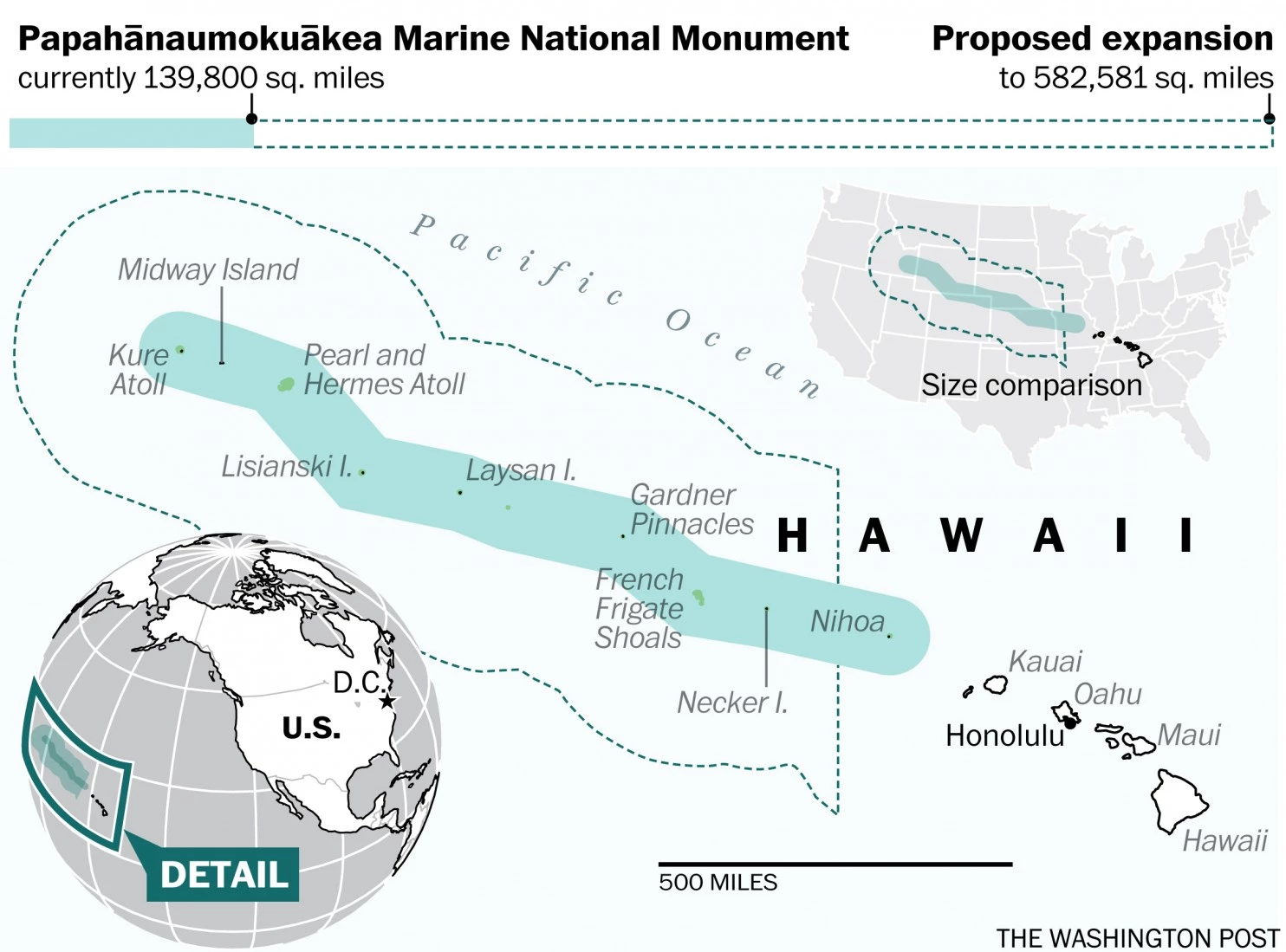
This morning, President Obama created the largest ecologically protected area on the planet when he expanded a national marine monument off the coast of his native Hawaii to encompass more than half a million square miles.
The president more than quadrupled the size of the Papahanaumokuakea Marine National Monument to 582,578 square miles of land and sea in the Northwestern Hawaiian Islands.
President George W. Bush established the monument a decade ago, but Obama’s action Friday underscores the high priority he has placed on issues of conservation and climate change in his second term. The president has now used his executive authority under the 1906 Antiquities Act to protect more than 548 million acres of federal land and water, more than double the set-asides of any of his predecessors.
Many scientists, environmentalists and Native Hawaiians have argued for more stringent protections for the biologically rich region, given important deep-water discoveries in the area and the dual threats of climate change and sea-bed mining.
“The oceans are the untold story when it comes to climate change, and we have to feel a sense of urgency when it comes to protecting the ocean that sustains us,” said Sen. Brian Schatz (D-Hawaii), who helped broker a compromise with groups including Native Hawaiians and day-boat fishermen.
In his official proclamation, Obama declared, “It is in the public interest to preserve the marine environment.”
All commercial extraction activities, including fishing and future deep-sea mining, will be prohibited in the expanded monument area. However, recreational fishing, removal of resources for traditional Hawaiian cultural purposes and scientific research will be allowed with a federal permit.
With Friday’s action, seven presidents — starting with Theodore Roosevelt in 1909 — have taken steps to safeguard parts of the archipelago, which is one of the most biologically diverse areas in the world. It is the planet’s largest seabird gathering site, with more than 14 million birds from 22 species, and is home to nearly all Laysan albatrosses and the remaining endangered Hawaiian monk seals.