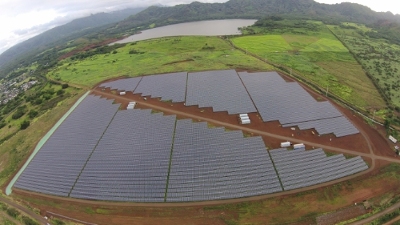
As reported by The Pacific Business News, The Kauai Island Utility Cooperative has struck a deal with California-based SolarCity to develop what would become one of the first utility-scale systems in the United States to provide the utility with electricity whenever it needs it.
On Wednesday, KIUC said that it has signed a power purchase agreement with SolarCity for the solar and battery storage system, which is designed to supply power to the grid in the evening, when demand is highest. This system will provide dispatchable solar energy through a 52-megawatt hour battery system that allows the electricity to be available when it's needed, even after sundown. This will reduce the amount currently used with diesel generators. SolarCity was the contractor on KIUC’s first 12-megawatt solar array in Koloa on the island’s South Shore, which went into commercial operation in Sept. 2014 and supplies about 5 percent of Kauai’s electricity.
By using the solar energy stored in the battery instead of diesel generators, KIUC said it will reduce its use of imported oil and also cut its greenhouse gas emissions. Under the terms of the 20-year contract, KIUC will pay SolarCity 14.5 cents per kilowatt-hour, a lower rate than the current cost of conventional generation, and only slightly more than the cost of energy from KIUC’s two existing 12-megawatt solar farms, whose output is available only during the day.
“KIUC has been investigating energy storage options for more than two years and price has always been the biggest challenge,” said David Bissell, president and CEO of KIUC, in a statement to PBN. “This is a breakthrough project on technology and on price that enables us to move solar energy to the peak demand hours in the evening and reduce the amount of fossil fuel we’re using.”
Pending state and county approvals, the array and battery storage facility will be built on 50 acres of land owned by Grove Farm Co. Inc. adjacent to KIUC’s Kapaia power station off Maalo Road, just north of Lihue. To qualify for federal tax credits that will substantially reduce the cost of the project, construction work must begin by April 2016 so the project can be in commercial operation by Dec. 31, 2016.